How to play blackjack: rules and first decisions
You are not trying to reach 21. You are trying to beat one hand: the dealer’s.
Updated 20 November 2026 · By Sir Croupier
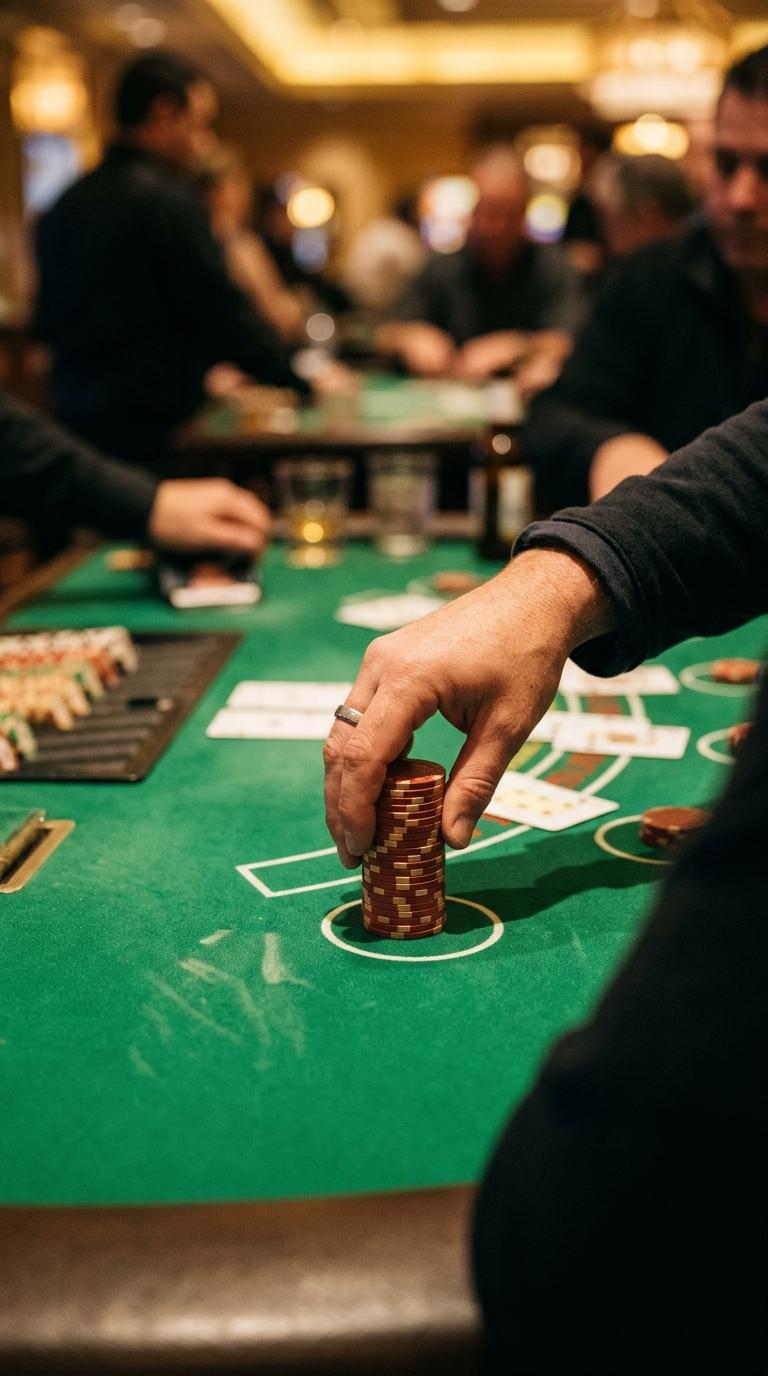
The aim
Finish with a hand closer to 21 than the dealer’s, without going over. Go over 21 and you are bust: you lose at once, even if the dealer busts afterwards. That one rule is where the house gets its edge.
Card values
- 2 to 10 count at face value.
- Jack, queen and king count 10.
- An ace counts 1 or 11, whichever suits your hand. A hand with an ace counted as 11 is called soft.
An ace with a ten-value card on your first two cards is a blackjack. It beats everything except a dealer blackjack and normally pays 3 to 2.
Your four decisions
| Decision | What it means |
|---|---|
| Hit | Take another card. |
| Stand | Keep your hand and end your turn. |
| Double down | Double your bet, take exactly one more card, then stand. |
| Split | With two cards of the same value, split them into two hands, each with its own bet. |
How the dealer plays
The dealer has no choices. They draw until they reach 17 or more, then stand. Because the dealer acts last, you can win simply by standing on a weak hand when the dealer is likely to bust.
Table rules worth checking
- Blackjack pays 3 to 2. Tables that pay 6 to 5 cost you noticeably more. Walk past them.
- Dealer stands on soft 17. Slightly better for you than a dealer who hits it.
- Double after split allowed. Another small gain.
- Skip insurance and most side bets. They carry a much higher edge than the main game.
Played by basic strategy at a table with good rules, blackjack has a house edge of around half a percent, one of the lowest in the casino. Once you know the basics, see how Hi-Lo card counting works and why it rarely applies online.
18+ only. Every casino game costs money on average. Set a limit first. Free help is listed on our safer gambling page.
Blackjack questions
What does blackjack pay?
A blackjack normally pays 3 to 2, so a £10 bet wins £15. Some tables pay 6 to 5, which raises the house edge and is best avoided.
Should I take insurance?
No. Insurance is a separate bet that the dealer has a ten in the hole. It pays 2 to 1 but wins less than one time in three, so it costs you money over time.
What is basic strategy?
A chart of the mathematically best decision for every combination of your hand and the dealer’s visible card. Following it brings the house edge to roughly half a percent under good rules.